



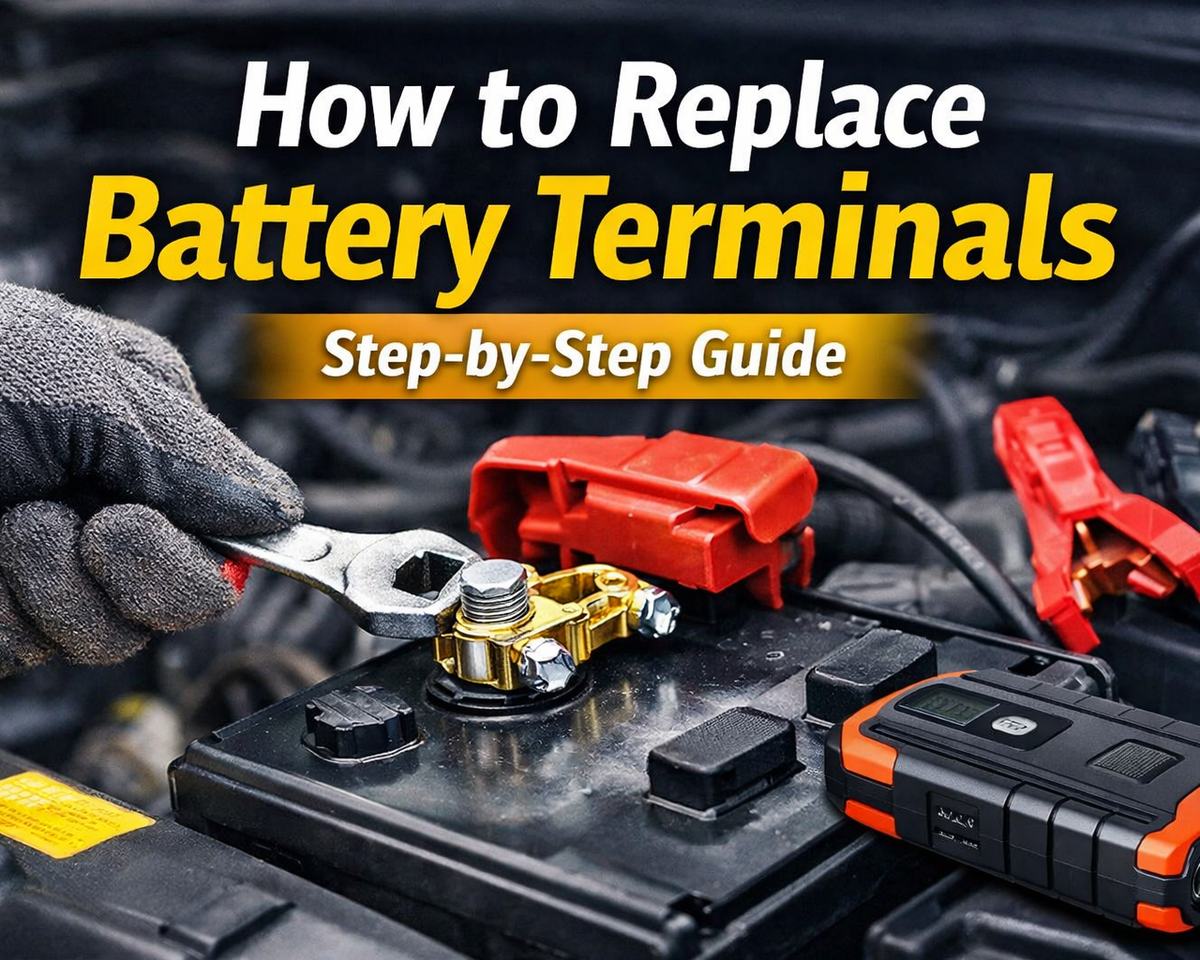
How to Replace Car Battery Terminals: Step-by-Step DIY Guide
|
|
Time to read 7 min
|
|
Time to read 7 min
Car battery problems are one of the most common reasons vehicles fail to start. Many drivers assume the battery itself is dead, but in many cases the issue is much simpler: damaged or corroded battery terminals.
Battery terminals connect the vehicle’s electrical system to the battery. If these connectors become loose, worn out, or covered in corrosion, electricity cannot flow properly. When that happens, you may notice slow engine cranking, flickering lights, or a car that refuses to start altogether.
Fortunately, replacing battery terminals is a simple and affordable repair that most car owners can do at home with a few basic tools.
Battery terminals are metal connectors that attach your car’s battery cables to the battery posts.
Most automotive batteries have two terminals:
These connectors allow electricity to travel between the battery and your vehicle’s electrical system. Without a solid connection, the starter motor may not receive enough power to crank the engine.
Over time, battery terminals can degrade due to:
When the terminals become damaged or corroded, replacing them can restore proper electrical flow.
Before replacing the terminals, confirm that they are actually the cause of the problem.
Here are several warning signs.
A white, green, or bluish powder around the battery connectors indicates corrosion. This buildup can block electrical conductivity and cause poor battery performance.
If corrosion is mild, cleaning may help. But severe corrosion often means the terminal should be replaced.
If the terminal clamp spins or wiggles on the battery post, it may be stretched or worn out. A loose connection can interrupt power flow and prevent the engine from starting reliably.
When the battery terminals cannot deliver enough current to the starter motor, the engine may crank slowly or struggle to start.
Sometimes drivers assume the battery is dead, when the real issue is a poor connection.
Bad battery terminals can also cause electrical issues such as:
If you experience these symptoms, inspecting the battery terminals is a good first step.
Replacing battery terminals does not require specialized equipment.
Most people already have the necessary tools at home.
You will need:
You may also need:
Most replacement terminal kits cost $10–$30 at auto parts stores.
Follow these steps carefully to replace your battery terminals safely.
Make sure the vehicle is completely turned off and the key is removed from the ignition.For additional safety:
Always remove the negative (-) terminal first.
Use a wrench to loosen the clamp and gently lift it off the battery post.
Disconnecting the negative cable first helps prevent electrical short circuits.
Next, loosen and remove the positive (+) terminal.
Be careful not to touch both battery posts with the metal wrench at the same time.
Many replacement terminals require cutting the old connector from the battery cable.Use wire cutters to remove the damaged terminal.
Then strip about ½ inch of insulation from the battery cable if necessary.
Check Before You Cut: Before using wire cutters, check if your old terminal is bolted to a metal ring (lug) at the end of the cable. If it is, simply unscrew the nut to swap the terminal. Only cut the cable if the terminal is permanently molded or crimped onto the wire.
Before installing new connectors, clean the battery posts thoroughly.
You can remove corrosion using:
Cleaning the posts ensures better electrical contact.
Pro Tip: When cleaning with baking soda and water, ensure the battery vent caps are tightly sealed. Do not allow any cleaning solution to seep inside the battery cells, as this can neutralize the acid and permanently damage the battery.
Attach the new terminal connector to the exposed battery cable.
Tighten the clamp so the wire is firmly secured inside the connector.
Reconnect the battery cables in the correct order:
Make sure both clamps are tight and do not move on the battery posts.
Start the engine to confirm the repair worked.
If the car starts normally and electrical systems function properly, the installation was successful.
An incorrect connection order can cause sparks or electrical damage.
Correct order:
Installing new terminals on dirty battery posts may still cause poor electrical connections.
Always clean corrosion first.
Loose connections can cause intermittent starting issues while driving.
Make sure the clamps are fully tightened.
If your car still won’t start after replacing the battery terminals, another issue may be responsible.
Possible causes include:
In situations where the battery suddenly dies, a portable jump starter can help start the vehicle instantly without needing another car.
Many drivers keep a compact jump starter in their trunk so they can start their vehicle anytime, especially during cold weather or long road trips.
These devices are designed to deliver enough power to start most vehicles within seconds.
Most battery terminals last 5 to 10 years, depending on driving conditions and maintenance.
Factors that affect lifespan include:
Regular inspections can help detect corrosion or looseness before they cause starting problems.
You can extend the life of your battery terminals with a few simple maintenance habits.
Preventive maintenance reduces the chance of unexpected breakdowns.
Q1: Can I replace battery terminals myself?
Yes, you can replace battery terminals yourself with basic tools such as a wrench and wire cutter. The process usually takes 30–60 minutes and does not require advanced mechanical skills. Just remember to disconnect the negative terminal first and follow proper safety precautions.
Q2: Do I need to replace both battery terminals?
No, you do not always need to replace both battery terminals. If only one terminal is damaged, corroded, or loose, you can replace that single terminal. However, replacing both terminals at the same time can improve reliability and ensure better electrical connections.
Q3: Can bad battery terminals prevent a car from starting?
Yes, bad battery terminals can prevent a car from starting. Corrosion, loose clamps, or damaged connectors can interrupt the electrical current between the battery and the starter motor. Without sufficient power, the engine may crank slowly or fail to start completely.
Q4: How much to replace battery terminals?
Replacing battery terminals is an inexpensive repair. Most replacement terminals cost between $10 and $30, while professional installation may cost $30 to $80 including labor. If you replace them yourself, the total cost is usually under $20.
Q5: Which battery terminal do you disconnect first?
You should always disconnect the negative battery terminal first. Removing the negative cable reduces the risk of electrical short circuits while working on the battery. After removing the negative terminal, you can safely disconnect the positive terminal.
Q6: What happens if you swap battery terminals?
If you accidentally swap battery terminals (connecting positive to negative and vice versa), it can cause serious electrical damage. Possible consequences include blown fuses, damaged alternators, electrical system failure, or even battery overheating.
Q7: What is the lifespan of a battery terminal?
Battery terminals typically last 5 to 10 years, depending on driving conditions, climate, and maintenance. Exposure to corrosion, battery acid, and vibration can shorten their lifespan. Regular inspection and cleaning can help extend the life of battery terminals.
Q8: How do you know if battery terminals are bad?
You can tell battery terminals are bad if you notice corrosion buildup, loose connections, difficulty starting the engine, or flickering electrical components. If cleaning the terminals does not solve the issue, replacing them may restore proper electrical flow.
Learning how to replace battery terminals is a valuable skill for any car owner. This simple repair can solve many starting problems and improve your vehicle’s electrical reliability.
With just a few tools and a little patience, most drivers can complete the repair at home in less than an hour.
For additional peace of mind, many drivers also keep a portable jump starter in their vehicle so they can restart their car anytime a battery issue occurs.
Proper battery maintenance and emergency tools can help ensure you're never stranded on the road.